How the economics of retirement differs in the US vs Germany: A Global Analysis
Ayan Mahajan and Abhijeet Patil
March 3, 2026
People spend almost their entire lives working, on average until the age of 65. Following that age, it becomes increasingly difficult for most elders to make ends meet due to a lack of income, especially for those without support from working family members. Hence, as a part of the country’s well being, it is important for governments to develop means to help sustain these populations and ensure they have adequate finances, resources, and access to critical services.
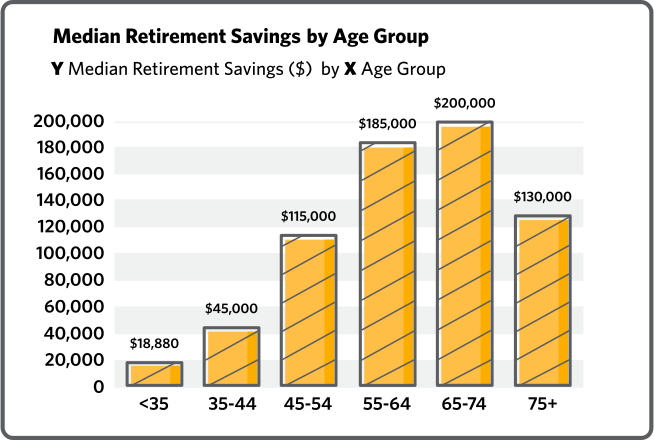
Source: Mutual of Omaha Mortgage
This article examines differences in retirement systems between the United States and Germany, shaped by factors such as personal investments, homeownership, and government welfare programs. Each country structures retirement support differently through a combination of public programs and employer-provided benefits, while demographic patterns influence housing, investment choices, and wealth accumulation—including stocks, bonds, index funds, and cryptocurrencies. Understanding these differences is essential, as nations must plan for both current and future retired populations, not merely to preserve wealth, but to protect older adults from poverty and ensure a basic standard of living.
USA
Retirement in the US is financially affected by Social Security and personal investments. Social Security acts as the government’s retirement floor for financial well being, funded mainly by payroll taxes, which are taxes incurred whenever businesses hire people. Contrary to popular belief, Social Security is not a replacement for a paycheck, but rather a basic means of preventing poverty for senior citizens with little to no sources of income. However, retirement is facing a looming crisis, one of the trust funds that Social Security relies on running out—according to the Trustees report, these trust funds are projected to disappear by the mid-2030s if government policy doesn’t change, which means that Social Security would be greatly tightened and less accessible as payroll taxes will become the primary, or even sole, means of covering benefits.
The second major factor affecting financial security post-retirement is personal investments, mostly in terms employment benefits and workplace plans like 401(k)s and personal IRAs. This results in a diverse array of retirement outcomes depending on access to different plans, your employer, and the pre-retirement income ability to make investments. The Fed’s Survey of Consumer Finances shows retirement accounts are existent, but their funds are unequally distributed.
These implications are amplified by culture and technology—retirement culture in America has a strong emphasis on individual responsibility, forcing people to take greater risks, but also making it likely for retired folk to fall into poverty absent external financial and monetary support. However, technological advancements have made a wide assortment of investments more accessible and easier to make, which paves the way for greater wealth accumulation for an elderly class through investments, but at the same time can increase the risk of economic downturns and single market events depleting people’s savings and investments.

*Identifies key difference between US and German investing portfolios that explain to an extend why retirees in the US end up wealthier than in Germany due to a greater number of investments (echoes to how investment is a bigger cultural trend in the US than most European countries)
Source: Klement on Investing
Germany
What largely shapes retirement in Germany is its public pension system. The public pension system is funded through mandatory payroll contributions by employees and employers. What contrasts with the US model is that Germany’s pension system is intended to replace a large portion of pre-retirement income rather than merely prevent poverty. Despite this, there are a number of demographic challenges that are putting pressure on the system, leading to declining replacement rates and concerns about long-term sustainability. These demographic challenges include an aging population and a shrinking workforce.
Germany’s broader welfare state plays a significant role in supporting retirees. Financial uncertainty is reduced by universal healthcare, long-term care insurance, and means-tested old-age assistance and further protects retirees from medical and longevity risks. While this lowers elderly poverty rates, it also requires high payroll taxes, which reduces disposable income during working years.
Another difference to the US is that homeownership is less central to retirement planning in Germany than in the US. Strong tenant protections and regulated rental markets make long-term renting common, limiting housing-based wealth accumulation. Mortgages are typically conservative, reducing financial risk but also slowing asset growth. Personal investments such as ETFs and index funds play a smaller role in German retirement security. Many households favor low-risk savings and insurance products over equities. Especially for younger workers, access to digital investment platforms has significantly increased. Despite this, overall equity participation remains limited, reducing long-term return potential.
Germany emphasizes stability and collective responsibility over individual risk-taking. This causes reduction of exposure to the market volatility but can lead to overly cautious financial behaviour. Labor market policies, including a rising retirement age and higher participation among older workers, aim to offset demographic pressures but have not fully resolved funding challenges.
Works Cited
Ebert, Sven. Saving in Germany and the USA: A Comparison. Flossbach von Storch Research Institute, 25 Mar. 2024, https://www.flossbachvonstorch-researchinstitute.com/fileadmin/user_upload/files/RI/Studien/Files/englisch/2024/240325-saving-in-germany-and-the-usa-a-comparison.pdf
. Accessed 2 Mar. 2026.
Germany Faces Accelerated Aging and Population Decline, Challenging Pension and Care Systems. Deutschland in English, 11 Dec. 2025, https://deutschlandinenglish.com/p/germany-faces-accelerated-aging-and-population-decline-challenging-pension-and-care-systems
. Accessed 2 Mar. 2026.
Hauser, Andreas. “Stock Ignorance in Germany. Why Do So Few People Invest in Stocks? Is It Worth Investing?” TransparentShare, 13 Aug. 2025, https://www.transparentshare.com/en/post/aktien-ignoranz-in-deutschland-wenige-menschen-investieren-in-aktien/
. Accessed 2 Mar. 2026.
“Chart: Where Do People Retire The Earliest (And Latest)?” Statista, 24 Mar. 2023, https://www.statista.com/chart/29570/european-average-effective-labor-market-exit-ages/
. Accessed 2 Mar. 2026.